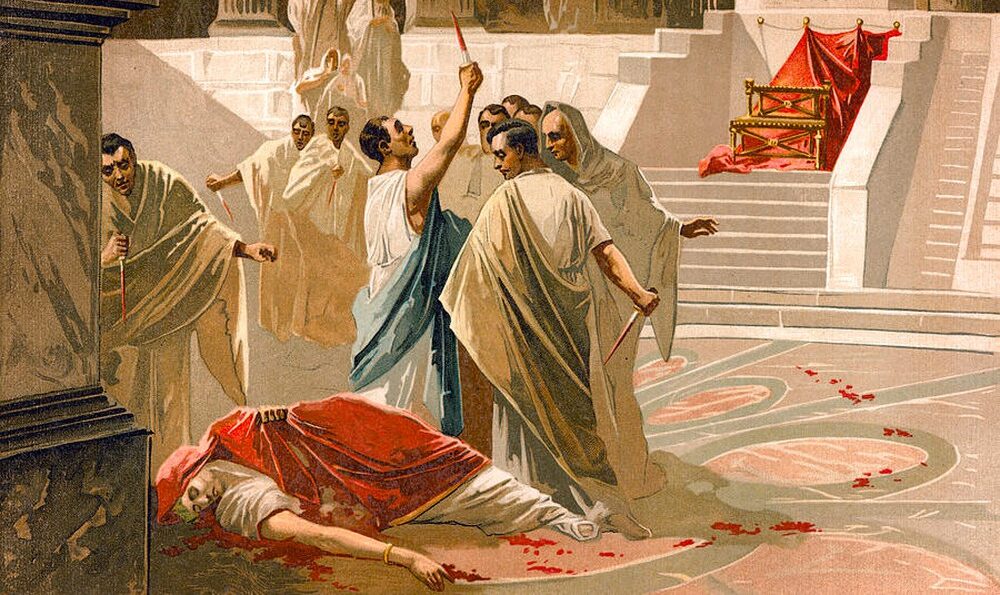
1. The Death of Caesar
Julius Caesar was the most powerful man at the end of the Roman Republic.
Caesar had made many enemies among Rome's powerful families by pushing for reforms (changes) that would benefit roman soldiers, and the poor of the cities. This included setting up a system of free food for the poor.
While Caesar was away, fighting in Gaul (modern France) his enemies in Rome ordered his arrest. Caesar returned to the city with his legions. This was a huge no-no since carrying weapons was banned in and around the city of Rome
This caused a civil war (a war within one country) between Caesar and the supporters of a different powerful politician, Pompey. When Caesar won, he seemed to now have total power. Many of his surviving enemies (and even some of his former friends) were worried that he would make himself king next!
These worried men carried out a conspiracy (plot by a group of people) to have Caesar murdered. He was killed during a meeting of the senate.
Division of Territory
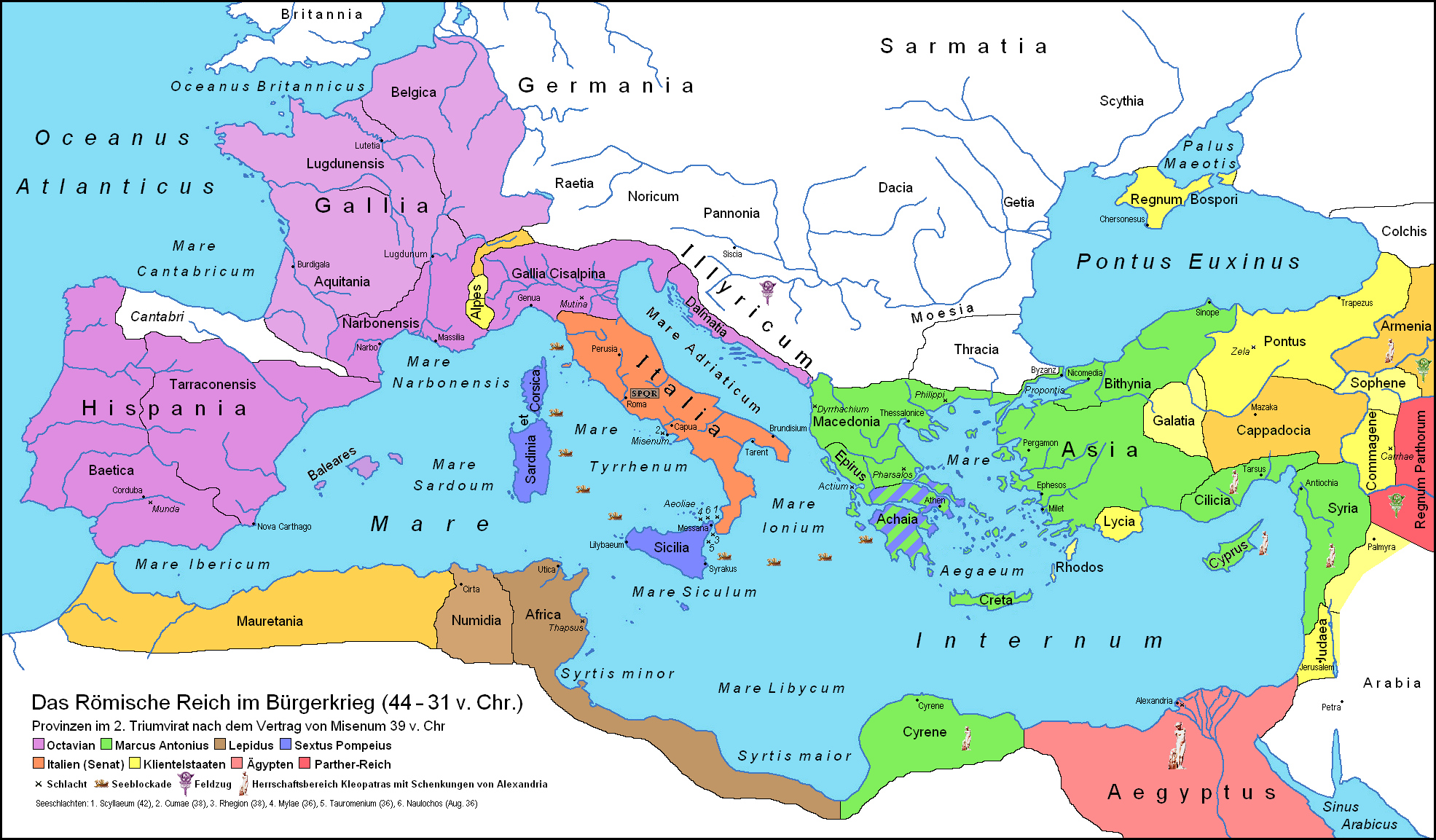
Map: Gaul, Hispania, Africa, etc. divided between Octavian, Antony, Lepidus.
2. The Rise of the Triumvirate
After the death of Caesar, his adopted son Octavian and his former general Mark Antony both tried to take control over the people fighting for revenge for Caesar.
In the end, Octavian and Antony agreed to share. Together with another of Caesar's former followers, Lepidus they agreed to split the empire between themselves and fight together against Caesar's killers.
This was called the "Triumvirate" because it had three leaders (tri). Octavian took the west (purple), Antony took the east (green) and Lepidus took the south (brown).
3. The Liberators' War
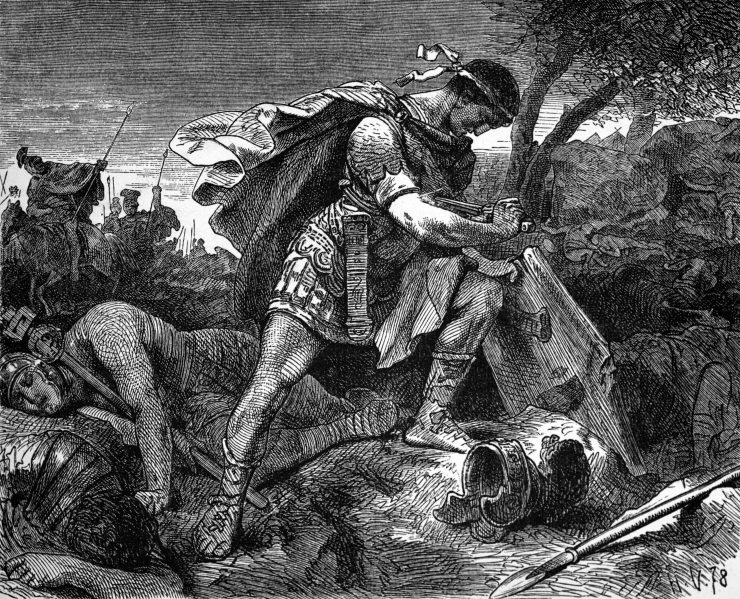
The fall of the "Liberators" at Phillipi
Together, Antony and Octavian invaded Greece where the "Liberators" who killed Caesar were hiding out.
The two sides fought at the First Battle of Phillipi which mostly was a stalemate.
The two armies then met again a few days later, at the Second Battle of Phillipi. This time, Caesar's main killer, Brutus and his army were defeated. Brutus committed suicide before Octavian could capture him.
With Brutus dead and the Liberators defeated, there was now nothing in the way of the "Triumvirate" ruling the entire Empire.
4. The War between Octavian and Antony/Cleopatra
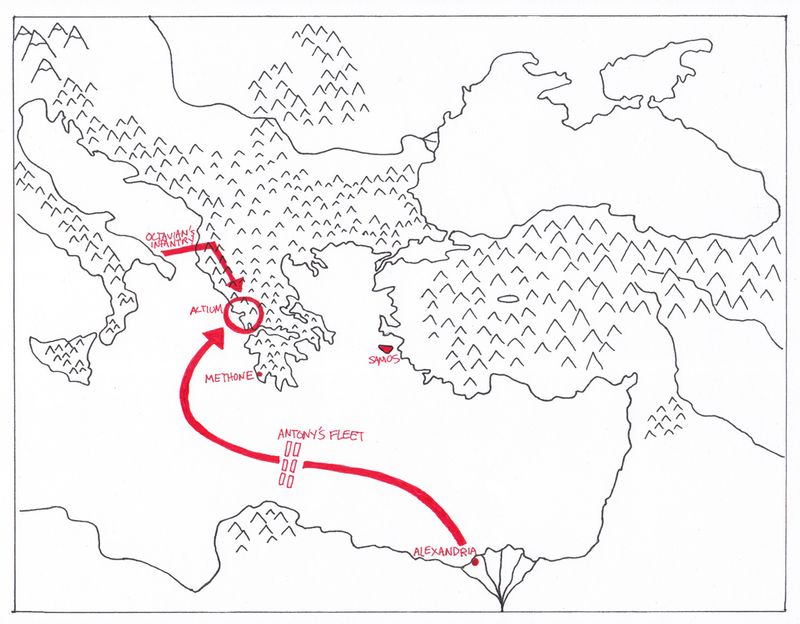
Naval battle of Actium (31 BC) and the campaigns in Greece/Egypt.
With the Liberators defeated, the Triumvirate began to fight each other for power. Octavian quickly removed Lepidus and took over his part of the Empire.
Antony began to build up his strength in the eastern part of the Empire. One focus of his was the powerful kingdom of Egypt which was a vassal state of Rome, meaning that while Egypt was independent, it still agreed to obey the Roman empire.
Antony began to get close to the Egyptian queen, Celopatra, eventually the two became lovers. Octavian used this as an opportunity to destroy Antony and take power for himself by convincing the Roman senate to declare war on Egypt.
This meant war! And the two sides met once again in Greece, at the Battle of Actium. One the one side were Octavian's forces, the Roman legions of the western part of the empire and on the other were the legions loyal to Antony and the Egyptian army and navy.
Octavian won, defeating Antony and Cleopatra, who both committed suicide. With Antony gone, now there was noone left to stop Octavian from becoming Augustus Caesar, the first Roman emperor.